

If you need to protect your critical and valuable assets Clean Agent Suppression systems should be preffered. Clean Agent Suppression Systems are used in places where you will have high cost in case of fire. Room integrity is an important criteria for clean agent suppression systems and must be provided. Equipment in protected enclosure would never harmed in case of fire and you can continue to use equipment after discharge. Design standards are NFPA2001, EN15004 and ISO14520. System certification (not only equipment) acredited by international associations like UL, FM, LPCB, VdS is very important when using clean agent suppression systems.

Agents used for clean agent suppression systems are classified into two groups
A) Chemical Agents are chemical materials invented in laboratories. Most known types are HFC-227ea (FM-200), HFC-125 (Ecaro-25) and FK-5-1-12 (Novec1230).
B) Inert Gases are natural gases which are already in nature like Argon, Nitrogen and Carbondioxide. They can also be used as blends. There are four main types (IG-01, IG-55, IG-541, IG-100).

HFC-227ea is the most known and used type of clean agent suppression systems and belongs to hydrofloro carbon family. It is invented by DuPont and named as FM-200®. HFC-227ea is stored as liquid and pressurized with nitrogen within cylinder. Discharge time is 6 to 10 seconds. Agent transforms to gas form at nozzle and must be hold at room minimum 10 minutes.

Halon1301 agent was the most used agent for fire suppression systems till mid 90’s. However Halon1301 is banned at 1994 and alternatively HFC-125 is invented by DuPont. Advantage of HFC-125 is using same infrastructure with Halon1301, so no need to make any change with piping. HFC-125 is stored as liquid and pressurized with nitrogen within cylinder. Discharge time is 6 to 10 seconds. Agent transforms to gas form at nozzle and must be hold at room minimum 10 minutes.

FK-5-1-12 or known trademark name as Novec1230® belongs to fluorinated ketone chemical family. FK-5-1-12 has very low GDP value. FK-5-1-12 is stored as liquid and pressurized with nitrogen within cylinder. Discharge time is 6 to 10 seconds. Agent transforms to gas form at nozzle and must be hold at room minimum 10 minutes.
Inert gases are naturally occur in athmosphere and used for fire suppression systems. Argon, Nitrogen and Carbondioxide are used for fire suppression. Inert gases are incondensible and stored as gas within high pressure cylinders. Cylinders have 200bars or 300bars storage pressure; however this pressure is regulated within valve and decreased to lower value like 42bars. So pressure within pipes or within protected enclosure is never larger than this value. System discharge time for inert systems are 120 seconds. As pressure is high, long piping distances can be used; so cylinders can be stored in a separate room far from protected area. Also more than one enclosure can be protected with one inert system with using selector valves. Inert fire suppression systems are much more cost effective when protected room quantity increases.

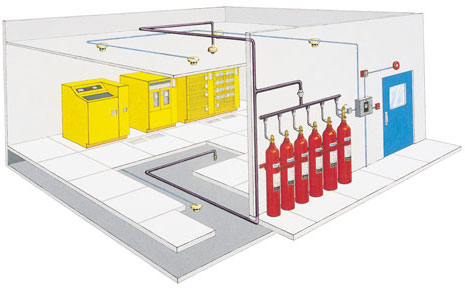
The engineering and design of clean agent fire suppression systems must follow the international standards NFPA 2001, EN 15004, and ISO 14520. For the system to operate flawlessly during a fire, it is a technical requirement that its components be certified by globally accredited bodies such as UL, FM, LPCB, and VdS.
Chemical agents (HFC-227ea, HFC-125, FK-5-1-12) are laboratory-manufactured, stored as a liquid inside the cylinder, and discharge through the nozzle in gaseous form within a short 6 to 10 seconds. Inert gases (IG-01, IG-55, IG-541, IG-100), made from naturally occurring gas components, cannot be liquefied; they are stored in gaseous form under high pressure — 200 or 300 bar — and delivered to the protected space over 120 seconds, with pressure regulated at the valve outlet.
Because inert gases are stored at high pressure — 200 or 300 bar — they allow piping to run over long distances. On multi-room, large-scale projects, a single system with a central cylinder bank and selector valves can protect multiple independent areas. This architecture eliminates the cost of installing a separate cylinder bank for each room, optimizing the overall budget.
For the room to retain the design extinguishing concentration, the protected space must be completely airtight. In critical areas such as data centers, server rooms, and UPS rooms, an enclosure integrity test (door fan test) must be performed. The advantage of the system is that the discharged clean agent causes no physical or chemical damage to sensitive electronic equipment, allowing operations to continue without interruption.
Halon 1301 systems, whose use was banned in 1994, can be modernized with HFC-125 (Ecaro-25®) gas while retaining the existing piping, fittings, and mechanical infrastructure. The greatest technical advantage of HFC-125 is that it is fully compatible with the hydraulic flow characteristics of the original Halon 1301 piping network, keeping infrastructure replacement costs to a minimum.
You can call by phone or write via the contact form,
Our experts will respond to you in detail as soon as possible.
Bizimle sohbet edin